What Northern Michigan residents should know about concentrated 7-OH, kratom products, withdrawal, and treatment
A federal notice was issued in early July that many people in Northern Michigan may not have heard about yet. In the coming weeks, however, some individuals and families could feel its effects directly.
The U.S. Drug Enforcement Administration has announced its intent to temporarily place concentrated 7-hydroxymitragynine—commonly called 7-OH—and several related substances into Schedule I of the Controlled Substances Act. The temporary order cannot take effect before August 5, 2026.
That language may sound technical. For someone who has come to depend on one of these products, the consequences may be anything but.
A product that has quietly become part of someone’s daily routine could soon disappear from store shelves. When it does, some people may experience significant withdrawal, uncertainty, and fear.
NMSAS Recovery Center wants our community to understand what is changing, what is not changing, and where people can turn for help.
Plain-Leaf Kratom and Concentrated 7-OH Are Not the Same
The DEA’s announced action does not apply to botanical kratom products containing only the naturally occurring, trace amounts of 7-OH found in the plant.
Plain-leaf kratom may be sold as:
- Powder or crushed leaves
- Capsules
- Tea
- Other products made primarily from the raw plant
The federal action instead targets products containing elevated concentrations of 7-OH, including synthesized or highly processed products that contain substantially more 7-OH than occurs naturally in botanical kratom.
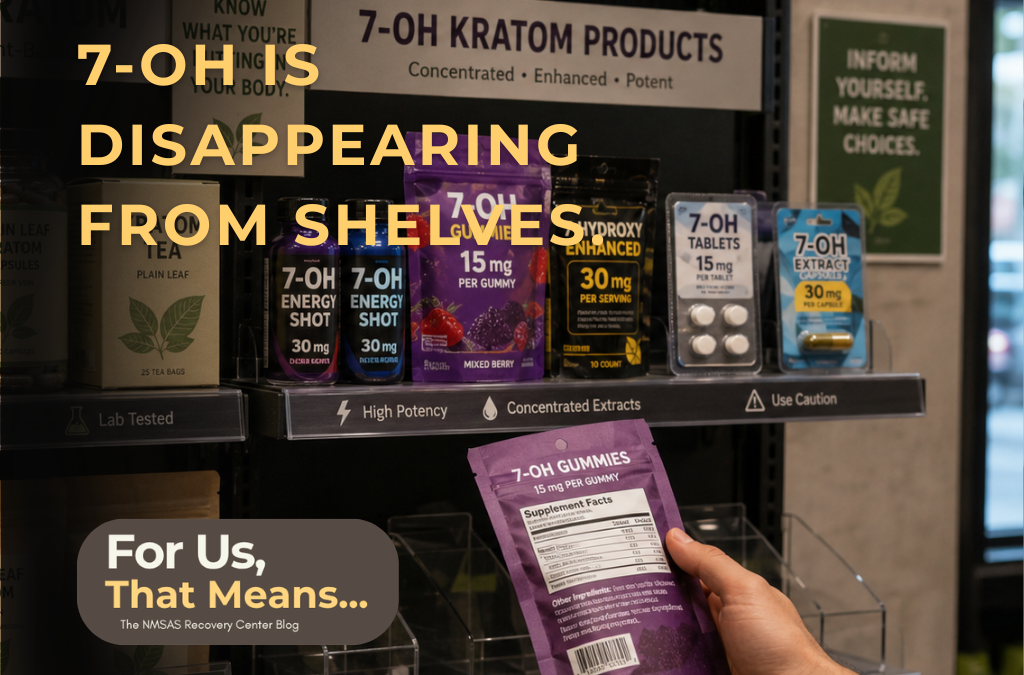
These products may be sold as tablets, capsules, gummies, powders, dissolvable strips, shots, or other “enhanced” products. Some may be marketed as kratom without clearly explaining how different they are from plain-leaf products.
That distinction matters.
A person may purchase something from a gas station, convenience store, smoke shop, or online retailer believing it is simply another kratom product. They may not realize that it contains concentrated 7-OH or that it can produce powerful opioid-like effects.
This is not necessarily a failure of judgment by the person using it. Product labeling and marketing can be confusing, incomplete, or misleading.
People should carefully examine packaging for terms such as:
- 7-OH
- 7-hydroxy
- 7-hydroxymitragynine
- A specific milligram amount of 7-OH
- “Enhanced,” “concentrated,” or similar language
Uncertainty about what a product contains is itself a reason to ask questions.
Dependence Is Not a Moral Failure
People begin using concentrated products for many reasons. Some are looking for relief from physical pain. Others are trying to manage anxiety, sleeplessness, emotional distress, opioid cravings, or the ongoing strain of a life that has become difficult to carry.
At first, the product may appear to help.
Over time, the body can adapt. A person may need more of the substance to experience the same effect, or may begin taking it simply to avoid feeling sick. What began as relief can gradually become routine, and routine can become physical dependence.
Most people do not plan for that to happen.
Physical dependence does not mean someone is weak, irresponsible, or beyond help. It means the body has adapted to repeated exposure to a substance.
That is biology—not a character defect.
What May Happen When Concentrated 7-OH Becomes Unavailable
People who regularly use concentrated 7-OH may experience withdrawal if they suddenly stop taking it.
Symptoms may include:
- Body aches
- Anxiety or restlessness
- Difficulty sleeping
- Nausea or gastrointestinal discomfort
- Sweating or chills
- Irritability
- Strong cravings
- A general feeling of being physically or emotionally unwell
The intensity and duration of withdrawal can vary depending on the product, the amount used, how frequently it was used, how long it was used, and the person’s overall health.
People should not assume they must manage this alone.
They also should not attempt to begin Suboxone or another buprenorphine medication obtained from someone else. Buprenorphine can be an effective and lifesaving treatment, but it must be started at the appropriate time. Beginning it too soon after certain opioid-like substances can trigger sudden and severe withdrawal.
Timing is not a minor technical detail. It is an important part of safe treatment.
NMSAS Can Provide Treatment Directly
The words “recovery center” can sometimes sound like a place that only offers information, encouragement, or referrals.
NMSAS Recovery Center is more than a referral point.
We are a direct medication-assisted treatment provider. Our medical and clinical professionals can evaluate what someone has been taking, assess their symptoms, determine an appropriate treatment plan, and prescribe medications when clinically indicated.
Someone who contacts NMSAS does not have to navigate a maze of disconnected programs before receiving care. We can help determine what needs to happen next and support the person through that process.
We believe treatment should be accessible, respectful, and grounded in what the person is experiencing—not in shame or judgment.
Too often, people do not avoid help because they do not want it. They avoid help because the path feels confusing, intimidating, or filled with expectations that they must first prove they deserve care.
At NMSAS, care begins with listening.
What You Need to Remember
Plain-leaf botanical kratom is not included in the DEA’s announced temporary scheduling action when it contains only naturally occurring 7-OH below the federal threshold.
Concentrated, synthesized, or elevated-strength 7-OH products are the focus of the action. The temporary scheduling order cannot take effect before August 5, 2026.
Anyone regularly using a product marketed as kratom should look carefully at its packaging. People who are unsure what they have been taking do not need to wait until they have every answer before contacting a healthcare provider.
If stopping the product causes withdrawal—or if someone is worried about what will happen when it is no longer available—help is available.
The Shelf May Change. Our Commitment Will Not.
Federal policies can change quickly. A product can disappear from a shelf overnight. The human body, however, does not understand regulatory timelines. It only knows that a substance it has adapted to is suddenly gone.
Our responsibility is to be ready before that happens.
NMSAS Recovery Center is not interested in judging why someone began using a substance. We are interested in what happens next—and in helping make sure that what happens next is safe, supported, and less frightening.
If this affects you or someone you care about, please contact us. You do not have to wait until withdrawal becomes unbearable, and you do not have to navigate it alone.
FREE one-pager on 7-OH Disappearing from Shelves (download here)
Northern Michigan Substance Abuse Services—NMSAS Recovery Center—is a direct medication-assisted treatment provider serving Otsego County and communities throughout Northern Michigan. Confidential support is available by calling or texting [PHONE NUMBER].
This article is intended for general education and should not replace individualized medical advice. Anyone experiencing severe symptoms, a possible overdose, difficulty breathing, loss of consciousness, chest pain, seizures, or another medical emergency should call 911 immediately.